Tuesday, 12 April 2011

Bibliography & Filmography

Bibliography

Ackroyd, P. (1979), Dressing Up: Transvestism and Drag: The History of an Obsession, Thames and Hudson: Great Britain.
 
Adelman, J. 'Making Defect Perfection: Shakespeare and the One-Sex Model' in Comensoli, V. and Russell, A. (ed.) Enacting Gender of the English Renaissance Stage, Urbana- University of Illinois Press (1999) Pg. 23-52.
 
Bailey, A. (2007), Flaunting: Style and the Subversive male body in Renaissance England. University of Toronto Press Incorporated: Toronto.

Blackemore Evans, G. (1990) Elizabethan-Jacobean Drama: The Theatre in Its Time New Amsterdam Books, New York.

Cordner,  M. and Holland, P. (ed.) (2007) Players, playwrights, Playhouses: Investigating Performance, 1660-1800. Palgrave Macmillan: Great Britain.

Fernald, M. and Shenton, E. (2006) Historic Costumes and How to Make Them, Dover Publications, Inc: New York.
 
Garber, M. (1992) Vested Interests: Cross-dressing & Cultural Anxiety. Routledge: United States of America.
 
Hudson, K. (1971) The Story of the Elizabethan Boy-ActorsOxford University Press: London.

Jones, A.R & Stallybrass, P. (2000), ‘Yellow starch: fabrications of the Jacobean court’ in Renaissance Clothing and the Materials of Memory, Cambridge University Press: UK. Pg. 59-86.
 
Jones, A.R & Stallybrass, P. (2000), ‘Transvestism and the “body beneath”: speculating on the boy actor’ in Renaissance Clothing and the Materials of Memory, Cambridge University Press: UK. Pg. 207-219.

Levine, L. (1994) Men in Women’s clothing: Anti-theatricality and effeminization 1579-1642. Cambridge University Press: Great Britain.

Marly, D.D. (1982), Costume on the Stage 1600-1940, B.T. Batsford Ltd: London.

Munro, L. (2005) Children of the Queen’s Revels: A Jacobean Theatre Repertory, Cambridge University Press: Great Britain.

Nicoll, A. (1963), Stuart Masques: And the Renaissance Stage, Benjamin Blom Inc: New York.

Shapiro, M. 'The Introduction of Actresses in England: Delay or Defensiveness?' in Comensoli, V. and Russell, A. (ed.) Enacting Gender of the English Renaissance Stage, Urbana- University of Illinois Press (1999) Pg. 176-185. 

Solomon, A. (2004) ‘Much virtue in if: Shakespeare’s cross-dressed boy-actresses and the non-illusory stage’ in Re-Dressing the Canon: Essays on theatre and gender, London: Routledge. Pg. 21 – 45.

Stallybrass, P. 'Transvestism and the ‘body beneath’ Speculating on the boy actor' in Zimmerman, S. (ed.). Erotic Politics: Desire on the Renaissance Stage, London: Routledge. (1992) Pg. 50-6. 

Vincent, S. (2003) Dressing the elite: Clothes in Early Modern England, Berg Publishers, New York.
 
Vincent, S.J, (2009), The Anatomy of Fashion: Dressing the body from the Renaissance to Today. Oxford: New York.
 
Zarralli, P.B, McConachie, B., Williams, G.J, Sorgenfrei, C.F. (ed) (2006) ‘Theatre and the state in England, 1600-1660’ in Theatre Histories: An Introduction. Routledge: Great Britain.

Zarralli, P.B, McConachie, B., Williams, G.J, Sorgenfrei, C.F. (ed) (2006) ‘Homoerotic desire and the boy actors’ in Theatre Histories: An Introduction. Routledge: Great Britain.

Filmography
 Orlando (Sally Potter, UK/Russia/France/Italy/Netherlands: 1992)
 
Shakespeare in Love (John Madden, USA/UK: 1998)


Sunday, 10 April 2011

Ideas and Scribbles

Inspired by my trip to the Globe's Archives, I have been sketching and scribbling notes and potential designs, as well as collecting potential fabric swatches which I might use for my final costume. Characters I create through cosplay I believe are partially born from the costume, the character isvaguely there, but the costume obviously is an intrinsic part of them, and therefore part of the character's personality/looks/behaviour etc. also comes out through the costume.

The period of which I'm making my costume had three notable differences between hose. Doublets generally had a similar style and cut, however hose differed  rather dramatically. To help myself gather a bit more understanding in the comparison - as well as considering which would be best suited for the actor-character who would have a hose suited to his personality.

Venitian Hose. French Hose (with cannions). Pluderhose (with cannions and pullings-through).

Venitian hose is considered to be more traditional more 'normal' looking hose. They were plainer, often worn by lower or 'meaner' classes, or would be worn by people who were more of the upperclass who liked to be taken seriously. The look was considered to have a more 'proper' look to it, than the other styles. I'm not entirely sure if I shall use Venitian hose in my designs yet, as to me, the look comes across as a much more sober, more 'adult' look. Whereas the actor-character I have playing around in my head would technically be a fairly young man considering he is still able to play the female leads of most plays, in this role he would be transitioning from an apprentice actor, to a full role.

'Starting ages for apprentice actors could vary from about ten to sixteen, and the length of service from three to ten years… Once trained, the play-boys could perform for several years in female roles before the onset of puberty, which occurred later than it does now, made them better suited to adult male roles.' (Shapiro, 184)

Due to this, I would feel his design would need a far more 'younger' quality to it, to suit the age of the character, and I feel, perhaps, that Venitian hose would not quite suit him. But I shall scribble up some designs and see what comes to me, and what works in my head.

The French hose is generally the one I believe most people are aware of in terms of clothing of the period - as these mostly feature in paintings and sketches and so on. They were considered one of the most fashionable of all the hose at the time. They could be with or without cannions (the strips of material that would stick out with them) - personally I prefer them with cannions. To me, this seems like the sort of style a younger man or a 'youth' would most likely wear - especially in very bright, bold colours. I feel perhaps my actor-character, seeing as he is young, would perhaps dare to have a pair of French hose with cannions - perhaps in some very bright bold colours to show his extrovert nature, and the position he plays in society.

The Pluderhose seem to be more of a Germanic or Scandinavian design. Big baggy hose, sometimes with added cannions and pullings-through for maximum effect. To the English, such a style was considered almost 'monstrous' in look, due to its excessive size and style put through it (in terms of trim and pullings-through).

'Richard Walweyn was detained for wearing 'a very monsterous and outraygous greate payre of hose'.' (Bailey, 26)

Scandinavian doublet and pluderhose with pullings-through.
Such a style could be assumed to be pluderhose. Though they may have been more of the norm in Scandinavian countries, the sorts of people who most likely would have worn pluderhose in England would have definately been people garnering for attention. As with the Globe's costume of Lucio, not only has he excessive pluderhose with a large codpeice, pullings-through, a combination of yellow and oyster pink. His hat and purse are equally excessive and large in comparison to more traditional styles of the period. Such a style could indeed work for the character I have in mind, as I imagine the actor to be quite the confident - almost cocky and brash character. He could perhaps concievably wear a pair of pluderhose to try and gather more attention unto himself.

The Globe Costume Archive: The Original Practices [Pt.4]


Measure for Measure by Shakespeare. Character: 'Lucio'
Pluderhose with oyster-pink cannions with matching tassle trim.

Yellow/gold pluderhose with cannions, and a codpiece with 'pullings through'.

Leather jerkin with designs 'stamped' and cut into the leather.

Leather jerkin with stamp designs and slashes (to be worn over doublet).

Yellow detachable sleeves with red satin lining, bronze buttons and matching trim.

Gold patterned doublet with yellow/red trim.

Matching black satin purse with pink tassles.

Large ruff with 16th Century lace trim.

Handmade 16th Century lace.

Large brim hat with decorative feathers, satin slashes and yellow trim.

Rosette on hat (matching ones on garters).
 Much Ado About Nothing by Shakespeare. Character: 'Hero'
Yellow dress (worn over a corset and smock)

Trimmed with gold. The dress is in the Italian style - it double laces at the back.

Laced on sleeves with metal buttons. Yellow silk satin lining.

Gold trim.

Tag to pick up the skirt - the dress has a very long train so it can be picked up to allow her to dance.

Lace robarto - most likely worn with the over dress.

Red and gold overdress - would be worn over yellow dress (could not be removed from the box)

Scallopes to make it look like the dress is in a 'classical' Roman style.

Wedding gloves to be worn with red dress.

Gloves with embroidery, spangles and gold trim.
Yellow linen Spanish farthingale - would be attached to corset via points.

French farthingale - would be tied about the waist.

Gold coif decorated with fresh water pearls.

Linen cuffs with 16th Century lace.

 Misc. Hats, Wigs, Garters, etc.
Benvolio's hat. [Romeo & Juliet by Shakespeare].

Malvolio's crossed garters. [Twelfth Night by Shakespeare].

Viola's shipwrecked wig made of brown & gold silk threads. [Twelfth Night by Shakespeare].

Olivia's wig made of black silk threads, tied in an 'up-do' with a bun and braids. [Twelfth Night by Shakespeare].

Maria's wig, made of horsehair. (Would have had a coif on the back). [Twelfth Night by Shakespeare].

Benadict's hat. Dyed fur. [Much Ado About Nothing by Shakespeare].


The Globe Costume Archive: The Original Practices [Pt.3]


A Winter's Tale by Shakespeare. Character: 'The Old Shepherd'
Hand-woven linen, organically dyed with 'madder' dye.

Sleeves sewn-in (would have originally been seperate). Silk decorated wooden button (this would have been very expensive for the working class!)

Quilted linen lining.

Pluderhose.

Woolen hose and garters, which are garter-stitched.

Start-up boots made of brown leather.


The Tempest by Shakespeare. Character: 'Prospero'
Sleeves (detachable). White cloth of silver with lurrex embroidery.

Doublet. Black cloth of 'silver'.

Doublet with black and silver embellishments and black 'cloth of gold' ribbon points. (There were lots of points so the actor could literally be cut out of his costume).

Quilting lining of doublet.

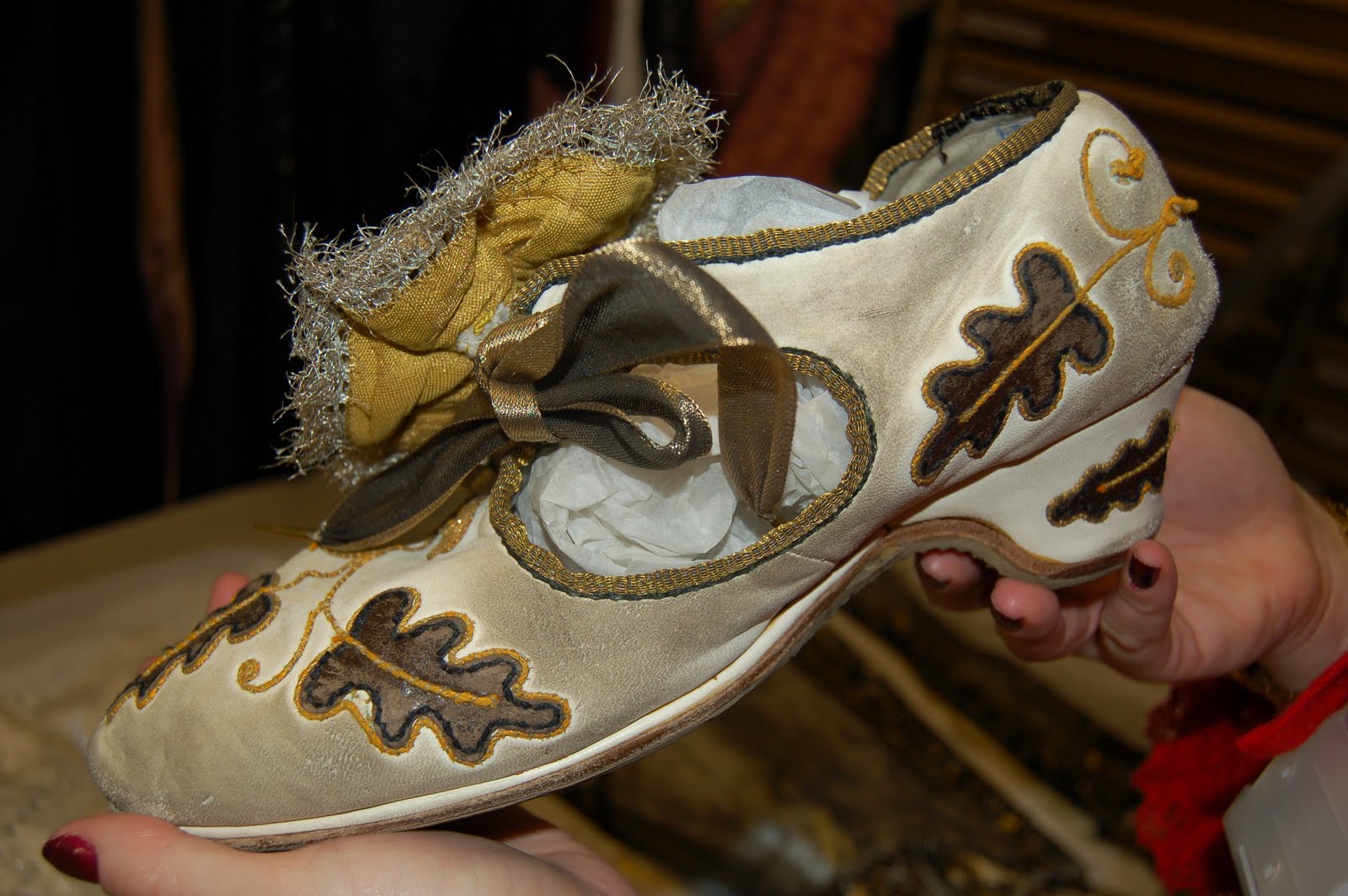
Shoes with embroidered oak leaves and shoe rosettes with gold trim.

Cream silk stockings with acord motifs.

Robarto neck-piece. (A rather femanine item)

Embellished with gold.

Linen britches with kabal symbols.

Black cloth of 'silver' pluderhose with velvet cannions.

Trimmed cannions with embroidered bees, snakes and frogs, with yellow and cream taffata lining.

Moleskin black hat, with silver ribbon, black and white feathers and gold trim.