Wednesday, 18 May 2011

Hair & Makeup

This is my hair and makeup test for when I dress as Samuel Daniel. I’ve tried to make myself look slightly more boy-ish in appearance, yet not too much, as I’m still supposed to look like a young man capable of performing as a woman on stage.

Makeup consists of a basic foundation and powder, followed by numerous applications of a brown shadow on various areas of my face to bring out more boyish aspects of my appearance. I have put shadows around my jawline to try and make it look a little more boyish, trying to square it out and make it more defined. I have a particularly rounded jawline, whereas men and boys have a more square-set one, so shadowing it should bring it out some more.

I also put shadows around the corners of my eyes to change their shape somewhat and to make them look more deeply set, while putting more around the edges of my nose to make it look thinner, and the corners of my mouth to make them look wider, and the shape to look somewhat different. Of course I have thickened and darkened my eyebrows to make them match the colour of the wig, and to again change their appearance and shape somewhat, while still trying to retain a fairly feminine look of my own. My hairline is shadowed, specifically my widow’s peak, just in case, before having a lace front wig put on top.

Hopefully I shall have a hat made by the time I begin to take photos of myself in the outfit and for the videos which should make the wig look more convincing – as it is usually the top of the head that tends to give away whether or not a wig is very obviously a wig, and a hat should be an easy enough way to get around that problem.

Monday, 16 May 2011

Making the Outfit


After researching at the Globe’s archives and costume department to see the traditional way in which the costumes were made, I have tried to create my own costume in a similar way, trying to use original ways in which the clothes were put together. I am attempting to use points to attach the various items of clothing together, such as the hose attached to the doublet, and the sleeves attached to the doublet also via a collection of points, tied together, therefore the sleeves would be detachable – in the style of the period. This would be done, as in the period people generally wore their wealth, as there were no real banks for people to contain their money. Their wealth would be in their belongings and their clothes. So should someone be short of money, they would sell items of clothing – such as their sleeves – to earn some money.

The original pattern I made was based off the pattern printed in Historical Costumes and How to Make them, it was very useful in giving me the basic shapes I needed, and included patterns for a doublet, hose, sleeves and a cape. I adapted the patterns slightly, such as the hose in the book were specifically Venetian hose, which, after the research I did pertaining to the type of clothes young men such as Samuel Daniel might have worn was not suitable. So I adapted the pattern into making a pair of French hose with added cannions instead. Similarly, the style of sleeves in the book were for the larger, more pronounced and stuffed sleeves of the earlier period of the middle 1500s, whereas Samuel Daniel’s style of clothing is based more on the early 1600-style of clothing, in which the sleeves were significantly less stuffed and were much tighter on the arms, and around the wrists.


I started work on the doublet first; I had managed to come across a lucky find in a charity shop of finding an old bed linen set of the colour and pattern-style I wanted for Samuel’s doublet. It was 100% cotton and perfect for what I needed. In my design, the doublet is an orange colour, trying to bring out the bright, youthful colours gentlemen of the period might have worn. I was hoping to find something with a matching pattern so it would look detailed and to the period, rather than having to make a pattern entirely from slashing the doublet in the style of the Romeo doublet at in the Globe’s costume archives. (The black doublet with pink slashings). Thankfully, the fabric I found had an interesting mix of oranges, yellows and terracotta’s which suited the style I wanted, and so I felt that was all that was needed. I tried to keep in style with the Globe’s way of making doublets, it was my first attempt at using quilting for the inner-lining of the doublet. All doublets were generally lined with quilting, due to the nature of the British weather being significantly colder than what it is today – of course, should the weather ever have gotten too hot, again, points could be used to remove one’s sleeves, and make the outfit a lot cooler.


While researching at the Globe I also took note of the shoulder-arches on most doublets, used to define the shoulders, I made a pair of these out of the same bed-linen material, while using the lining of the bed linen as lining for the shoulder arches themselves. They are stuffed with wadding to give them the particular pronounced look of the period. As luck would have it, after I raided my gran’s sewing box for anything that could be useful to me, I came across some spare material which I believe might have been used to upholster an armchair. The material was a dark orange/brown colour, and had a rather ‘nubbly’-texture to it, which I felt was quite suitable for the period I was aiming for with my doublet. So along the edge of the shoulder-arches I have piped the material to again, give it a more defined quality.


I used the same upholstery material to make the collar for the doublet, the darker colour offsetting the lighter yellow of the pattern on the doublet very nicely. I felt the colours all easily complimented each other, and gave the doublet an almost continental look, with all the oranges, yellows and terracotta’s. However, in the design I wanted to make a stark contrast between colours, by using bright blue against orange. Clothing of the period was particularly bold and colours were often mixed and matched as people were far braver in trying out colour combinations which might not fully mix such as blues mixed with green and green and pink and so on. So to try and recreate this bravery with colours that people had of the time, I needed a good blue to offset with the oranges of the doublet. I had come across a lovely turquoise inkle braid which I have used as a trim on the edging of the entirety of the doublet. It is a different colour blue to that of the hose, but the fact that there is blue still included creates – I believe – a good balance between both matching the rest of the outfit, and also creating the stark contrast with the rest of it.


Unfortunately no matter how hard I tried I could not find any suitable buttons to be used that were the same as the sort I found up at the Globe. The buttons there were round wooden buttons that had then been covered with silk thread to match the doublet. I tried to find such round wooden buttons but to no avail, so I had to search for buttons which I felt would be just as suited to clothing of the period. I came across a collection of buttons that had the look of dark leather plaited together. Leather at the time was very easy to come by, and the pattern was simple, yet elegant and I felt it suited what I needed very well. Also, the darkness of the buttons I felt brought the doublet to life, considering the rest of the doublet colours are very light and bright. The button loops are simply plaited string sewn together.


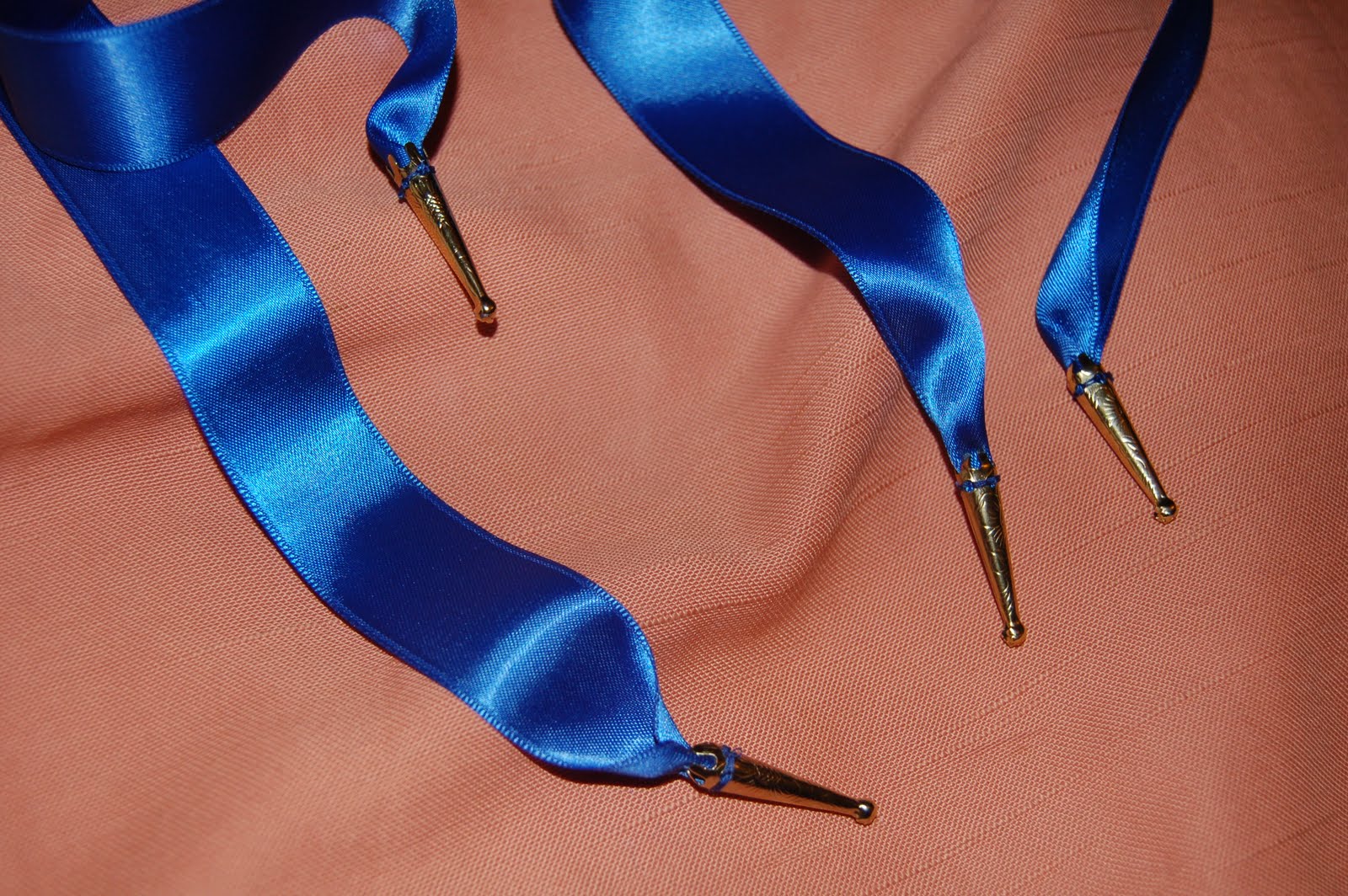
The Globe outfits had hand-stitched eyelets for which the points could be threaded through. These would be used to tie the various pieces of one’s outfit together, such as the doublet, hose and sleeves. (I unfortunately did not have enough time to put eyelets on the sleeves – but this will be rectified once I get the outfit back from assessment.) I did not have time to do my own hand-stitched eyelets, so instead I used grommets instead as a way of threading the points through. The points themselves are based off the points I saw used at the Globe. They are blue ribbon with metal corset nubs sewn onto the ends, which would then be threaded through the eyelets. [I need to sew a large collection of these to tie everything together.]


The sleeves are made of blue silk dupion with peach underlining and quilting for the lining. The blue is bright enough to make a stark contrast between the colours on the rest of the doublet, and matching the cannions on the hose. They are slashed so as to show the peach underlining, done in the style of the period and to match the rest of the doublet. Eyelets will be added around the edge of the upper sleeves to thread points through which would allow the sleeves to be attached to the doublet.


The hose were sewn from the pattern used in the book as before, though I shortened them somewhat so as to make them French Hose, which are considerably shorter than that of Venetian hose. They are made from gold silk dupion which shines blue in the light, the hose are stuffed with wadding to make them thick and stick out. The cannions are blue silk dupion with small slashes, stuffed with wadding with gold embroidery appliquéd on in a decorative manner. The lower britches are the underside of the fabric used for the doublet, a darker orange in colour with the yellow thread-swirls and patterns used on the underside to try and match the colours, but still have a bit of variety on par with the rest of the hose.


Sunday, 17 April 2011

Group Critique with Leigh Clarke.

It is always disheartening when the first thing you are told after you have done your presentation is "I'm sorry but I don't know much about your particular subject." I really don't understand the point of someone who does not necessarily know what I am talking about to then go and critique my work or my work practice. What is the sense in that? If you want to sort out something with your account you would in theory go to your bank - not to the local fish and chip shop to ask for advice. It seems this is the case however with the critiques. You have one single person come in and discuss all the different matters from Fine Art, Photography, Costume, Graphic Design and so on. I am not putting the person critiquing at fault - it is not their fault if they do not know every aspect of all the different MA pathways that are being done - but considering the university is taking it upon themselves to open up more MA pathways in the future, I certainly think they should take it upon themselves to revise the whole Group Critiquing system.

That being said, even though Clarke knew little about the subject matter, his words and suggestions were very interesting - it was just a shame it had absolutely nothing to do with my subject matter (another disheartening point). I explained from the top my line of thought, creating a character, how I wanted to do it, etc. and I ended up mentioning and showing my original designs for the character - the regency uniforms. I mentioned how I enjoyed military uniforms, especially historical ones and so on, before going off and saying how instead I wanted to focus on something different, and hence I went into the Jacobean side of things.

The impression I got was he chose to pretty much blank out the rest of what I said. He mentioned going to the Globe was very good, and showed I put in hard work, and then he said "You may want to look into this or ignore it altogether" Obviously, I was a littler apprehensive about hearing what he had to say after that remark. At which point he went on a massive tirade about military uniforms, how they had different meanings nowadays since we (ordinary citizens) are not involved in wars, it is the army that deal with them, and therefore wars and ergo uniforms do not mean the same thing anymore.

His notes I was given:
  • Military clothing connotations
  • Regimes
  • Dick Jewell - Kinky Galinky, 80's
  • Old Vic
  • Boy George/Leigh Bowery/80's
  • Beatles Sgt. Pepper Cover
  • Wearing propaganda - book
Which was all well and good, I found it all very interesting as I do generally have an interest in military uniforms - I like making them, looking at them and studying them. However the frustrating thing was that currently I am NOT doing any work on military uniforms, I'm working on Jacobean clothing and I have no interest in changing my work in Phase 2 currently.

That being said, it did strike a thought for me as I remembered an event that happened fairly recently in regards to historical military and so on. As said I have always been a fan of military uniforms, historical military campaigns and so on. When I was younger - about the age of eleven, I was watching a historical documentary on television which had reenacted scenes in it. I said to my dad how I wished to be in such scenes and I wondered how they got people to do it. At which point my dad pointed out to me that there were such things as historical reenactment societies and I could always research them and get involved if I wanted to. Which I did. Unfortunately, at the age of eleven there are few companies that are willing to take you on with an adult, much less on your own. Also, where I am from, Sussex, there are few historical battlegrounds and historical buildings about that do not involve the Vikings, Saxons or Medieval Knights - as much as I enjoy this history, I have little interest to join a society where I run around in chainmail all day. So I left it for many years, hoping to eventually get involved in a society when I was older, and able to get to places by myself. Unforauntely, due to College and eventually University, I was not able to take a look until quite recently when I knew I would be leaving education at the end of this year, and would have some more time to persue historical reenacting as a hobby.

Immediately a found a list of numerous websites for Napoleonic Reenactment groups throughout England - as that was the period of military history I am interested in the most (I adore the height of regimental discipline, the wonderful array of uniforms - as it was for me, when military attire was at its most ornate and decorative - where war was almost an event for a gentlemen to dress in their finaries, as they would for dinner or some other highly proper event). Much to my frustration however, there were many groups that stated on their websites how women who wanted to join could only be 'camp followers' and not be involved in the army ranks whatsoever. (To me, a 'camp follower' essentially accumulates to being a 'groupie' which is not what I wanted to do. I want to get involved in the fighting, I want to shoot rifles and muskets and march with the men in glorious uniforms). Most websites however did not specify, and I sent plenty of emails out to them in hope to get a response about whether I could join as a girl. All of them said no, most of them stating 'it is not historically accurate'.

Of course, I was very angry about this, 'not historically accurate'? Had a black man asked to join, would they also have said no because it was 'not historically accurate'? I also sent emails stating that I was happy to pretend to be a boy for events. I sent photos of me in my male costumes, bound, with fake facial hair and make up to make myself look more manly, saying I would happily be assumed to be a boy and leave it at that. Again, all the replies I got refused my entry, stating that 'there was no historical evidence to suggest a girl dressed as a boy in our particular regiment'. Firstly, I had told them to assume I was not a girl for events, and that I would happily be considered a boy - not a girl dressed as a boy. Secondly, there are plenty of instances of female crossdressers involved in the army, such as Nadezhda Andreyevna Durova [Russian], Friederike Krüger [Prussian], Anna Lühring [Prussian] and James Barry [British] plus more which I haven't researched more in-depth as of yet. I have to say, I was genuinely shocked, and rather upset, that after so many years of looking forward to joining something so much, suddenly I was refused to do what I wanted, simply because of my gender. That is the most frustrating thing. I am not allowed to do something because of my genetics, something I cannot physically change. I understand the need for historical accuracy, however, when I have stated that I am happy to present myself as a boy at all times, I see little need for there to be complete refusal. I can bind my breasts and pack my trousers to appear as a man, and yet, simply because on its most basic level, I am still a girl, my position in a fake, historical army, I am refused. It is historical, but we are still in the modern day. There is supposed  to be equality between genders and yet, due to 'historical accuracy' I am only allowed to swoon as a camp follower instead of doing what I really want to do.

The feelings that stirred up in me during this experience really got me angry. Perhaps it would be interesting to do a project on that for Phase 3? Or perhaps it is too late to rethink things. At the moment, I have so far ceased my attempts to join a historical reenactment society as quite frankly, I do not want to join a group that would refuse my attendance simply due to the fact I have breasts and no penis. (Though my friends had suggested to me I turn up dressed as a boy anyway and see what they say and do - though I do not feel I have the confidence to do that).

I have to say after these experiences I wouldn't mind researching military uniforms (and maybe making them in the future) or considering the viewpoint of gender in the military throughout history - or researching further into crossdressers of the Napoleonic Wars perhaps but really, right now I do not have the time to suddenly do a massive U-turn in my Phase 2 bit of the project. Maybe I'll reconsider Phase 3. However, I don't want to seem like I'm flailing over the place. I shall have a discussion at my next tutorial appointment for Phase 3. But for now I'm still working on my Jacobean outfit - which is going very well.

Tuesday, 12 April 2011

Character & Designs

The young actor is confident, border lining on cocky. He is proud of his position, playing the heroine leads, perhaps even slightly smug in the knowledge that not everyone can play such roles. He is well versed in how to play a female character, and probably likes to demonstrate his skills at any available oppertunity - because they are skills he is most proud of being able to perform.

‘Historians know little about the acting style of adults on the renaissance stages and less about the techniques used by boys to impersonate women. The skimpy evidence does suggest that the boys playing major female roles attempted to fully embody the voice, movements, and emotions of their characters rather than merely indicate them. That Shakespeare wrote such complex psychological portraits as Juliet, Rosalind and Cleopatra, also suggests that his company had boy actors who could play these roles believably.’ (Zarralli, 211)

 Alongside this, he is probably secretly quite pleased when another antitheatricalist pamphlet comes out - almost in a sense, enjoying causing a reaction out of them. He is happy to be bright, and bold with the colours he wears and isn't afraid to make a statement with his clothes. He is generally cheerful, however, he can sometimes be antagonistic about certain matters that displease him - especially things relating to the words said by the antitheatricalists, sometimes being sarcastic or just plain rude. While playing his femanine roles, he can take on a very demure attitude, however, he always likes to point out that he is one of the best at 'swooning' in London:
‘…swooning would have been among a boy-actress’s best tricks.’ (Solomon, pg. 32)
THE DESIGNS
Yellow & Black design. Pluderhose with cannions, leather jerkin and wide-brimmed hat.
 As much as I enjoy the design with the pluderhose and the added jerkin, I feel perhaps that the design is actually a bit too over the top for the character in question. Similarly, there is the added fact that black was rarely a colour worn by anyone other than the nobility. Admittedly, clothes were handed down and sold by numerous people, so theatres, actors and ordinary people could concievably get their hands on clothes with black in their colouring.
‘The head of the Rose Theatre, Philip Henslowe, for instance, regularly rented out and sold items of apparel that had been used as costumes. Most of the profits that he received from such arrangements were for less than thirty shillings, indicating that small sums of money could allow one to purchase clothes that, although thread-worn, still conveyed some sense of resplendence.’ (Bailey, 43)
Similarly, matters such as the cloak - which in my desgin has some gold trim on it - this would actually be considered inaccurate for an actor to wear outside of the playhouse. This is due to a law made that said only people of royal status could have highly decorative cloaks, to show their status. Lord Wessex's cloak in Shakespeare in Love (Madden, 1998) is lovely, but is decorated to such an extent that would rival a King or Prince's attire - a way in which nobles and other sorts would get around these laws, would be to find a loophole that allowed them to have all the decoration, embroidery, trim, etc. sewn onto the underside of the cloak. So perhaps I would have the design within the cloak, but still keeping it simple so as not to look as though it is rivaling a true noble's clothing.

Also, as much as I enjoy the ridiculousness of the pluderhose, and the fact that my character would perhaps like all the attention he would gain from wearing such an obvious 'look at what I'm wearing' style of clothes - I do not feel these would be quite so suitable for a young character such as mine would be. I feel that the design itself is a little too over-the-top, even if the character himself is quite proud in his styles. I feel like such apparel would suit someone particularly proud of their sexual prowess (yellow stockings are alluring and crossed-garters were considered 'sexy' in Jacobean England - hence the mockery Malvolio recieves in Measure for Measure.) and therefore for someone like the boy-actor, I think it would be interesting if his outfit had a younger, more naive look to it.

Blue and Green design. Venitian hose and slashed sleeves.
This next design is with Venitian hose, a style more often worn by British gentlemen, as it had a more serious - less ostentatious look to it - yet would still concievably be worn in a bright array of colours - the Jacobeans were far braver with mixing colours than we are today. However, they were limited by other things, such as:
'During the 1560s and onwards there was a significant increase in laws, legislation and proclaimations which announced the type of clothing people of the realm could, and could not wear, on account of class, rank and estate. ‘Much of the 1562 edict was devoted to determining which rank of men could wear what kind of hose and, according to the proclamation, servants were allowed to wear plain hose only. As members of ‘the meanear sort,’ male sevants, apprentices, and students were not permitted to wear hose made of velvet, satin, or ‘any other stuff above the estimation of sarcenet or taffeta’ or stockings that were stuffed with more than a yard and three quarters of material.' (Baliey, 27)

Therefore I tried to go with a more subdued design in regards to my second design, trying to take into account the numerous laws that were in place. Also, I felt that the character does view himself as a very well-versed member of his profession. He is good at what he does, and he knows it. Therefore, I felt like trying to make a design that conveyed the impression of him strutting around with the opinion of "I am a serious actor!" As for whether he would be taken as seriously as his clothes is anyone's guess. However, as much as I enjoy the design, I feel it perhaps isn't quite so fitting for a young man of about 17 years (puberty happened a lot later in this period, and so he could still convincingly play a female role on the stage). Especially as it was often stated how young men of the period would present themselves in public. Stephen Gosson, an antitheatricalist of the period would state that...

‘...young men wear sumptuous clothes not simply to role-play but to play it up. ‘To jet’ meant to carry oneself in an affected way and to convey an ostentatious manner, for instance by strutting ‘like a peacock or turkey’. (Bailey, 24)
 While also, it must be stated that:

‘The clothing proclamation of 1588, for example, boldly asserts that youths practise ‘excesses of apparel’ more than any other group.’ (Bailey, 25)

In this respect, I therefore feel that the almost subdued look of the green and blue design isn't quite so fitting for a man of his age and profession. As I am quite sure, from what I imagine the young man to appear like is a far more out-going, brighter colour combination and style of clothing for his appearance. (After all, his personality seems to be fairly outgoing, it would make sense that his clothing-style matched his personality). As much as I enjoy the Venitian hose as well, I feel a younger man of the period is more likely to have hose with cannions to show off and to 'jet' as it were when out and about, before performing his role on stage. (However I very much enjoy the slashing on the sleeves for this design, so I may take it and use it on my final design.)


Orange & Blue design. French hose with cannions, flat cap and slashed sleeves.
My final design has French hose and cannions - a more elaborate style of dress more akin to the 'ostentatious' apparel young men might have worn at the time, than the more subdued Venitian hose, and the slightly 'monstrous' Pluderhose. I wanted the colours to be bright and bold to match my character's personality - there will, additionally, be gold trim and decorations on the design (that can't really be seen in the picture). Even though there were the clothing proclaimations, it has to be noted that Gossen states that:
'...‘her majesty’ and ‘her honourable council’ have repeatedly ‘set down limits of apparel to every degree’, in the form of laws that regulate dress in accordance with the wearer’s rank and income. Yet stage players, to Gosson’s indignation, disregard these restrictions.’ (Bailey, 23)
 Therefore, such a bright array of colours, large French hose, some decorative gold trim and so on, perhaps would be suitable not just for the age of the character, in regards to the likelihood of him getting dressed in hopes to 'jet' while out and about. But similarly, it would also match in the fact that he, as a stage player, might (according to Gosson anyway) somewhat disregard the restrictions put in place over the laws that regulated dress in England at the time - I feel if Gosson felt this particular way, my character most likely would have particularly worn such clothes so as to provoke this sort of reaction out of other antitheatricalists. So such an outfit seems quite appropriate for him.

I feel out of all the designs number 3 is probably the most appropriate for my character in regards to the research I've done on young men and their apparel in the period, as well as the way actors dressed, and how I wished for my own character to be viewed. I think the colour combination is bold and makes a statement - quite perfect for my boy-actor who would most likely enjoy being able to do that. I shall make a pattern for the doublet, hose and cape, while also collecting swatches of fabric to use for the outfit.